The Role of Women: Resilience and Resistance in the Select Works of Scholastique Mukasonga
DOI:
https://doi.org/10.55578/jlcas.2603.004Keywords:
Postcolonial Feminism, Women’s Resilience, Cultural Memory, Trauma Narratives, Feminist Resistance, Cultural PreservationAbstract
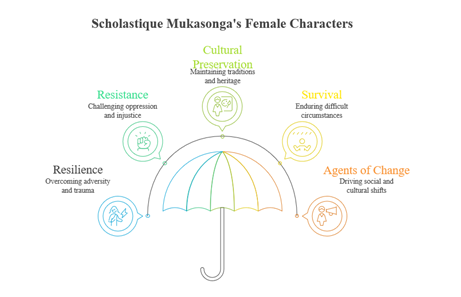
The Rwandan Genocide remains one of the most devastating events in modern history, profoundly affecting Rwanda’s social structures and collective memory. In the aftermath of this tragedy, women emerged as central agents of survival, reconstruction, and cultural preservation. This study examines the representation of women’s resilience and resistance in the selected works of Scholastique Mukasonga, focusing on Our Lady of the Nile (2014), The Barefoot Woman (2018), Cockroaches (2016), and Kibogo (2021). Grounded in postcolonial feminist theory and trauma studies, the research employs qualitative textual analysis to explore how Mukasonga portrays female characters navigating violence, displacement, and cultural disruption. The study argues that Mukasonga’s narratives reposition Rwandan women not merely as victims of genocide but as active agents of resilience, memory, and cultural continuity. Through storytelling, maternal knowledge, and communal solidarity, women in these narratives preserve indigenous traditions and challenge colonial and patriarchal structures that historically marginalized their voices. Furthermore, Mukasonga’s works reveal how literature functions as a site of cultural remembrance and resistance, enabling the reconstruction of suppressed histories and identities. By foregrounding women’s experiences, the study contributes to broader scholarly discussions on gender, trauma, and post-genocide memory within African and postcolonial literary studies. Ultimately, the research demonstrates that Mukasonga’s literary representations transform narratives of suffering into narratives of endurance, cultural survival, and feminist resistance.
References
[1] Des Forges, A. (1999). Leave none to tell the story. New York: Human Rights Watch.
[2] Burnet, J. E. (2012). Genocide lives in us: Women, memory, and silence in Rwanda. University of Wisconsin Pres.
[3] Spivak, G. C. (1988). Can the subaltern speak? In C. Nelson & L. Grossberg (Eds.), Marxism and the interpretation of culture. University of Illinois Press.
[4] Mukasonga, S. (2014). Our Lady of the Nile (M. Glasser, Trans.). Archipelago Books.
[5] Mukasonga, S. (2022). Kibogo (M. Glasser, Trans.). Archipelago Books.
[6] Mukasonga, S. (2012). Cockroaches (J. Cullen, Trans.). Archipelago Books.
[7] Mukasonga, S. (2008). The Barefoot Woman (J. Cullen, Trans.). Archipelago Books.
[8] Diboyan, L. M., & Goliath, J. R. (2023). Publicly underrepresented genocides of the 20th and 21st century. Humans, 3(2), 82-105. https://doi.org/10.3390/humans3020007
[9] Brewin, C. R., Atwoli, L., Bisson, J. I., Galea, S., Koenen, K., & Lewis-Fernández, R. (2025). Post-traumatic stress disorder: evolving conceptualization and evidence. World Psychiatry, 24(1), 52-80. https://doi.org/10.1002/wps.21278
[10] Isgandarova, N. (2023). Post-traumatic growth and resilience in victim-survivors of genocidal rape. Pastoral Psychology, 72(3), 417-430. https://doi.org/10.1007/s11089-022-01040-4
[11] de Beer, A. M. (2025). Trauma and storytelling in Rwanda. In The Palgrave encyclopedia of cultural heritage and conflict. Springer. https://doi.org/10.1007/978-3-030-81859-3
[12] Nowotny, J. (2020). The limits of post-genocide justice in Rwanda. Contemporary Justice Review, 23(4), 401-429. https://doi.org/10.1080/10282580.2020.1814896
[13] Bigabo, F., Biracyaza, E., Kanazayire, C., Kangabe, J., & Gishoma, D. (2025). Reconciliation villages in post-genocide Rwanda. Discover Social Science and Health, 5(1), 60. https://doi.org/10.1007/s44155-025-00060-3
[14] Brett, R., English, R., Féron, É., & Rosoux, V. (2024). Embodied reconciliation: a new research agenda. Peacebuilding, 12(1), 102-119. https://doi.org/10.1080/21647259.2022.2156162
[15] Li, J., Batamuliza, M., & Karangwa, E. (2022). Heroines who are rebuilding their country: State-society circumstances and coping strategies of female leaders in post-genocide Rwanda. Chinese Journal of Sociology, 8(4), 534-561.
[16] Jin, X. (2025). Land dispossession as continuum of violence: women's political agency in post-genocide Rwanda. The Journal of Peasant Studies, 52(4), 787-809. https://doi.org/10.1080/03066150.2024.2407167
[17] Nwakanma, A. (2025). Rethinking Women's Economic Power Beyond 'Hard Work': Wealth Insights from Fieldwork in Rwanda and Nigeria. Development, 68, 266-278. https://doi.org/10.1057/s41301-025-00462-6
[18] McClintock, A., Spivak, G. C., Mohanty, C. T., Nayaran, U., & Yuval-Davies, N. (2024). Imperialism, Colonial Discourse and Women. In Roads to Decolonisation (pp. 89-111). Routledge.
[19] Kamlongera, M.I. (2025). The Quandary of 'Decoloniality' as an Act and Academic Stance Within a Ph.D.: A Retrospective Narrative Autoethnography. In: Mahali, A., Tate, S.A. (eds) Dialogues on Decolonizing the University. Mapping Global Racisms. Palgrave Macmillan, Cham. https://doi.org/10.1007/978-3-031-94451-2_9
[20] Zahedypour, H. (2026). "Oppression of women through decolonial and feminist lenses". The SoJo Journal: Educational Foundations and Social Justice Education, Vol. ahead-of-print. https://doi.org/10.1108/SOJO-09-2025-0025
[21] Cornwall, A. (2026). Troubling gender in international development. Third World Quarterly, 1–23. https://doi.org/10.1080/01436597.2025.2600552
[22] Purdeková, A., & Mwambari, D. (2022). Post-genocide identity politics and colonial durabilities in Rwanda. Critical African Studies, 14(1), 19-37. https://doi.org/10.1080/21681392.2021.1938404
[23] Barakat, T. (2024). Translation and memory. In The Routledge handbook of translation and sociology. Routledge. https://doi.org/10.4324/9780367810137
[24] Taylor, L., Sollange, U., & Rwigema, M. J. (2015). The ethics of learning from Rwandan survivor communities: Critical reflexivity and the politics of knowledge production in genocide education. Beyond testimony and trauma: Oral history in the aftermath of mass violence, 88-118.
[25] Longman, T. (2023). Memorializing violence as a political tool. In Violence and public memory. Routledge. https://doi.org/10.4324/9781003303297
[26] Fryer-Davis, V. (2024). Memory dialogics: Scholastique Mukasonga's literary renegotiation of Rwandan genocide narratives. Memory Studies, 17(4), 887-903. https://doi.org/10.1177/17506980231176974
[27] Gowsalya, P., & Jothi, C. (2025). She who remembers: Gendered trauma as survival and resistance in Scholastique Mukasonga's writing. International Journal of English Language and Literature Studies, 14(3), 192-206. https://doi.org/10.55493/5019.v14i3.5519
[28] Creswell, J. W., & Creswell, J. D. (2018). Research design: Qualitative, quantitative, and mixed methods approaches (5th ed.). SAGE.
[29] Felman, S., & Laub, D. (1992). Testimony: Crises of witnessing in literature, psychoanalysis, and history. Routledge.
[30] Barry, P. (2017). Beginning theory: An introduction to literary and cultural theory (4th ed.). Manchester University Press.
[31] Braun, V., & Clarke, V. (2006). Using thematic analysis in psychology. Qualitative Research in Psychology, 3(2), 77-101. https://doi.org/10.1191/1478088706qp063oa
[32] Mohanty, C. T. (1988). Under Western eyes: Feminist scholarship and colonial discourses. Feminist Review, 30, 61-88. https://doi.org/10.1057/fr.1988.42
[33] Visser, I. (2014). Trauma and power in postcolonial literary studies. In R. Craps & G. Buelens (Eds.), Contemporary approaches in literary trauma theory (pp. 106-129). Palgrave Macmillan. https://doi.org/10.1057/9781137367820_7
[34] Mohanty, C. T. (1984). Under Western eyes: Feminist scholarship and colonial discourses. Boundary 2, 12(3), 333-358. https://doi.org/10.2307/302821
[35] Arnds, P. (2022). Trauma, memory, and reconciliation in post-genocide African literature. Journal of Postcolonial Writing, 58(3), 325-338. https://doi.org/10.1080/17449855.2022.2049921
[36] Bonnerjee, J. (2020). Narratives of endurance: Gender, trauma, and memory in postcolonial literature. Postcolonial Text, 15(2), 1-17.
[37] Ahmed, S. (2019). What's the use? On the uses of use. Duke University Press.
[38] Butler, J. (2021). Gender trouble: Feminism and the subversion of identity (2nd ed.). Routledge. https://doi.org/10.4324/9780429500495
[39] Mbembe, A. (2019). Necropolitics. Duke University Press. https://doi.org/10.1215/9781478007225
[40] Hooks, B. (2014). Talking back: Thinking feminist, thinking black. Routledge. https://doi.org/10.4324/9781315743187
[41] Crenshaw, K. (2019). On intersectionality: Essential writings. The New Press.
Downloads
Published
Data Availability Statement
The raw data supporting the conclusions of this article will be made available by the authors, without undue reservation.
Issue
Section
License
Copyright (c) 2026 Gowsalya Paulraj, Jothi Chidambaram (Author)

This work is licensed under a Creative Commons Attribution 4.0 International License.